
Heat Pump Repair & Service in Greater Houston
Heat pumps handle both your winter heating and summer cooling—when they fail, your entire home’s comfort is at risk. LMH Services responds quickly with technicians trained on ducted heat pump systems. We diagnose heating and cooling failures accurately, explain your repair options, and restore balanced year-round climate control.
Get a Free Estimate
Request service, book online, get a free estimate, ask about financing, or schedule routine maintenance.
Schedule Your Service For urgent issues, calling 832-800-4564 is the fastest way to reach us.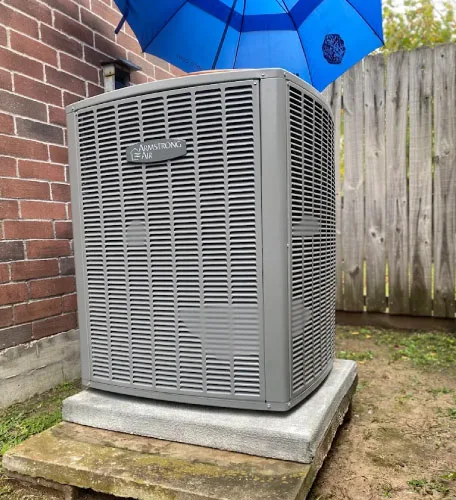
What Sets Our Heat Pump Repair Service Apart
Heating and Cooling Diagnosis in One System
A heat pump failure might show up as weak heating in winter or poor cooling in summer—but the cause could be the same problem: low refrigerant charge, a stuck reversing valve, or electrical issues. Our technicians understand heat pump operation in both modes and use diagnostic tools to find the real problem without guessing. Is the system not heating because the reversing valve is stuck in cooling mode? Or because outdoor coil is frozen? We measure superheat and subcooling, verify reversing valve operation, and check defrost cycle function to pinpoint the exact failure.
Experience with Both Heating and Cooling Seasons
Many HVAC technicians specialize in either heating or cooling, but heat pump repair requires expertise across both seasons. We diagnose year-round operation, understand how auxiliary heat engages in winter, and verify that defrost cycles work correctly so your system doesn’t freeze during cold snaps. When heating is weak but cooling works fine (or vice versa), our cross-season knowledge finds the root cause quickly.
Honest Repair-vs-Replace Guidance Based on Efficiency
A heat pump failure in winter is urgent—homeowners feel pressure to replace the system immediately. We evaluate honestly: Is this a straightforward capacitor fix, a valve replacement, or does compressor failure make replacement smarter? We also discuss efficiency: a 15-year-old heat pump repaired today might be less efficient than a new one over the next 10 years. We show you the numbers so you decide based on facts, not panic.
Armstrong Air Expertise
As an Armstrong Air Pro Team dealer, we specialize in those systems and also install and service Samsung heat pumps. These brands have specific failure modes, known component weaknesses, and particular refrigerant requirements. Our technicians know which parts fail first and how to diagnose them reliably.
Fast Response to Winter Heating Emergencies
When heating fails in January, waiting days isn’t an option. We offer same-day emergency service because cold weather affects vulnerable family members. We carry common replacement parts for heat pump systems to fix problems on the first visit whenever possible, reducing repeat appointments.
Proud Members of Our Local Chambers of Commerce



What Houston-Area Homeowners Say
How We Diagnose and Repair Your Heat Pump System
From the first phone call to final testing in both heating and cooling modes, every step is documented and done to code — so your heat pump performs reliably year-round.
When you call, we ask: Is the problem heating, cooling, or both? What’s the season and outdoor temperature? Has this happened before, or is it new? Is it an emergency (family without heat in freezing weather)? This intake shapes our response—winter heating failure gets immediate dispatch; summer cooling issues get scheduled promptly.
We also ask about system age, warranty status, and maintenance history. A heat pump that’s never been serviced may have low charge from a slow leak; one that’s recently serviced might have overcharge from a top-off.
Our technician arrives and checks: Is the outdoor unit running (compressor humming, fan spinning)? Are there any visible ice formations on coils or lines? Is the indoor unit delivering conditioned air? Do vents feel warm (heating mode) or cold (cooling mode)? This visual check quickly reveals whether we’re dealing with a no-operation problem or degraded performance.
We check the thermostat display to see what mode it’s calling for (heat vs. cool) and what the system is doing (matching or mismatched). A thermostat calling for heat while the system delivers cool immediately points to reversing valve trouble.
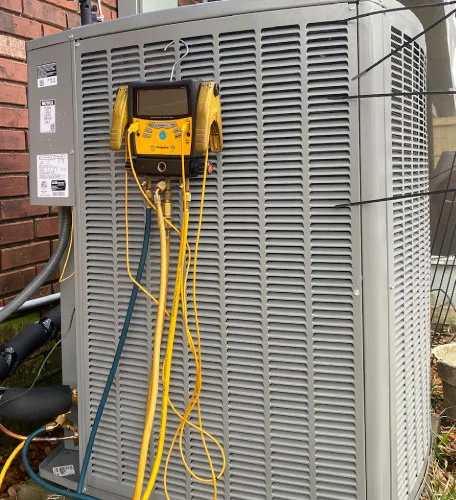
We connect manifold gauges to measure low-side and high-side refrigerant pressures. Heat pump pressure readings differ from air conditioner readings because the system operates in two opposite modes, but the fundamentals are the same: proper charge shows normal pressures; low charge shows low low-side pressure; overcharge shows high pressures.
We measure pressures in both heating and cooling modes if possible, comparing them to the system’s design specifications. A low-side pressure that’s abnormally low in heating mode points to refrigerant leak or a stuck metering device. A pressure that’s high in cooling but low in heating might indicate reversing valve malfunction.
We calculate superheat on the low-side line and subcooling on the high-side line in both heating and cooling modes. This data tells us whether refrigerant charge is correct, too high, or too low.
- In cooling mode: High superheat points to low charge or restriction; low superheat points to overcharge.
- In heating mode: Abnormal superheat suggests low charge or compressor issues; abnormal subcooling suggests charge or high-side restriction.
Heat pump superheat and subcooling are different than for a simple AC system because refrigerant direction reverses. We account for this difference during calculation.
We verify that the reversing valve switches correctly when you change the thermostat from heating to cooling mode. We listen for the valve solenoid to energize (audible click or buzz), then verify that the system responds—thermometer at indoor vents should change from hot to cold (or vice versa) within a minute or so.
We also test the defrost cycle in heating mode: the heat pump should periodically pause heating (you’ll notice a brief warm air stop), energize a solenoid valve, and run the compressor in reverse to defrost the outdoor coil. If defrost isn’t working, ice can build up and prevent heating.
We test capacitors (common failure points), compressor continuity, contactor operation, and fan motors using multimeters and specialized testers. A failed capacitor might prevent the compressor from starting in heating mode but not cooling. We isolate which component isn’t working.
We also test the thermostat’s reversing valve signal. A thermostat that isn’t sending the correct signal to the reversing valve solenoid explains why the system won’t switch modes.
We inspect the indoor evaporator coil for ice formation, frost, dirt, or visible damage. We check the outdoor condenser coil for debris, leaves, or ice accumulation. Poor outdoor coil function (from blockage or ice) is a common cause of weak heating in winter.
We verify that return air is flowing freely—no blocked filter, no closed vents. Blocked returns can starve the system of air to condition, causing weak heating and cooling and potential coil freezing.
If pressure readings suggest refrigerant loss, we use electronic leak detectors to scan all refrigerant connections, both coils, and line joints. Heat pump systems have more connections than simple AC (reversing valve solenoid, liquid check valves, defrost valve) so more places for leaks.
Once we locate a leak, we identify its severity and location—surface leak on a line connection (simple solder fix), or internal coil leak (more involved repair).
We explain findings clearly: “Your low-side pressure is reading 40 PSI in heating mode when it should be 55 PSI. We found a slow leak in the heating line connection. Your reversing valve is responding correctly, compressor is running, and defrost cycle is functioning. The repair is a solder fix plus a refrigerant recharge—about [cost]. With proper charge, you’ll get full heating output again.”
We present options for major failures: compressor replacement vs. system replacement, with honest economics.
Once approved, we proceed:
- Leak repair and recharge: Purge, solder, pressure-test, evacuate, and recharge with manufacturer-specified refrigerant.
- Reversing valve replacement: Requires partial refrigerant evacuation and careful component swap to avoid air entry.
- Defrost valve repair: Replace solenoid or valve body if stuck; test defrost cycle after replacement.
- Capacitor or contactor replacement: Quick swap with immediate testing.
- Compressor replacement: Full refrigerant evacuation, compressor swap, and precise charge.
All work follows EPA regulations.
After repair, we test the system in both modes: call for heat, verify that warm air flows from indoor vents, check that reversing valve clicks, measure pressures and superheat in heating mode. Then call for cooling, verify cold air output, check pressures in cooling mode. We run the system through a complete heating-cooling cycle to confirm balanced operation.
We test defrost cycle in heating mode by letting the outdoor coil ice up slightly, then verifying that defrost energizes and defrosts the coil without stopping heating to the home.
We document all pressure readings, component test results, and repairs for your record. We explain what we found and what habits prevent future failures.
Your Heat Pump Needs Diagnosis
Whether heating is weak, cooling has failed, the system is making noise, or auxiliary heat is running constantly, contact us for professional diagnosis.
Financing Your Heat Pump Repair
A major heat pump repair shouldn’t strain your budget, especially during emergency situations. LMH Services partners with Wisetack for flexible financing, so you can restore your year-round comfort and pay over time.
Financing Benefits


LMH Services has partnered with Wisetack to give you more ways to pay. Wisetack lets you check your options in seconds with no impact to your credit score, and offers simple monthly payment plans without the financial stress.
Keep Your System Running Strong with a Maintenance Plan
Prevent heat pump failures before they happen. A maintenance plan from LMH Services keeps your system efficient in both heating and cooling modes, extends its lifespan, and catches small issues before they become costly emergency repairs — for both Deer Park homes and businesses across the greater Houston area.
Our Maintenance Plans Include
24 Hour Service Available
Plan members get priority access to our 24/7 emergency service line
Prompt, Local Service
We are locally operated in Deer Park and respond quickly
Expert Technicians & Installers
Thorough inspections that catch small issues before they become expensive repairs
Residential & Commercial
Plans tailored to homeowners and business owners alike
Heat Pump Repair Across Greater Houston
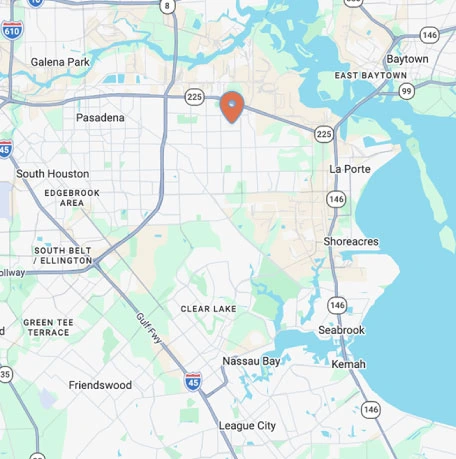
LMH Services repairs heat pump systems throughout the greater Houston area from our home base in Deer Park, TX. Wherever you are in our service area, you get the same expert diagnosis, honest recommendations, and reliable repair.
Serving Communities Around:
Not Sure If We Service Your Area?
Chances are we can help! We’ve served the southern Houston area for a while, so please call 832-800-4564 or contact us today to see if we come out to your area.
Heat Pump Repair Questions Homeowners Ask
Weak cooling in summer or weak heating in winter (or both) is the primary symptom. If pressure readings are low and we detect a leak with our electronic leak detector, you have a leak. Another sign: if the system worked fine last year but this year shows degraded performance without any service between seasons, a slow leak is likely.
Your heat pump delivers warmth by extracting heat from outside air; this is primary heating. Auxiliary heat is electric resistance heating that engages when the primary system can’t keep up (very cold outdoor temps) or when heating is completely lost. Auxiliary heat is less efficient. If auxiliary heat is running in mild winter weather, something is wrong with the primary heat pump.
Heat pump repair is possible in winter, though diagnosis is trickier when it’s cold. If heating has failed completely, we prioritize emergency dispatch. If heating is weak, we work around weather to diagnose and repair. Never wait on heating in winter—cold indoor conditions damage property and endanger occupants. Call immediately for emergency service.
Repair costs vary widely. Capacitor replacement might be a few hundred dollars. Refrigerant leak repair depends on leak location and volume—could range from a few hundred to over a thousand. Reversing valve or compressor replacement is more expensive. We diagnose first and provide an estimate before you approve the repair.
System age, repair cost, and efficiency matter. If your system is under 10 years old and repair cost is less than 30–40% of replacement cost, repair usually makes sense. If it’s 15+ years old and repairs are becoming frequent, replacement might offer better value over the long term. We discuss both options honestly and help you understand the economics.
Heat pumps are noisier in heating mode than cooling because of compressor operation and the reversing valve clicking during mode switch. A loud compressor noise or high-pitched hissing during heating might indicate high pressure (refrigerant overcharge or condenser blockage). Grinding noise suggests compressor bearing wear. Strange noises warrant diagnosis.
Simple repairs (capacitor, contactor) take 1–2 hours. Leak diagnosis and repair may take 2–4 hours depending on leak location. Reversing valve or compressor replacement may take most or all of a day. We estimate during diagnosis and coordinate timing so you understand how long your home will be without heating or cooling.
Yes, if we properly identify and fix the cause. A heat pump repaired correctly will deliver balanced heating and cooling performance. We verify operation in both modes before we leave so you can confirm it’s working.
Annual maintenance—coil cleaning, refrigerant leak checks, electrical connection verification, filter changes, and defrost cycle verification—catches small problems before they become failures. Regular maintenance on a maintenance plan is the best insurance against emergency repairs.
If the thermostat is set to heat and the indoor unit is blowing cold air (or no air), the reversing valve is likely stuck in cooling mode. We test by switching the thermostat and listening for the solenoid valve click; if you don’t hear it or the system doesn’t respond, reversing valve failure is probable. Diagnosis with gauges and electrical tests confirms it.
Get Expert Heat Pump Repair in Greater Houston
We diagnose heat pump problems in both heating and cooling modes using proper pressure readings, superheat calculations, and reversing valve testing. Our technicians understand year-round operation and find the real problem without guessing.
When heating fails in winter, waiting days isn’t an option. We offer same-day emergency service and carry common replacement parts to fix problems on the first visit whenever possible, reducing repeat appointments.
We evaluate repair costs against system age and efficiency honestly. Is this a straightforward capacitor fix or does compressor failure make replacement smarter? We show you the numbers so you decide based on facts, not panic.
As an Armstrong Air Pro Team dealer, we know these systems’ specific failure modes and component weaknesses. Our technicians understand which parts fail first and how to diagnose them reliably.
Major heat pump repairs shouldn’t strain your budget, especially during emergencies. We partner with Wisetack for flexible financing, and our maintenance plans help prevent future failures.